
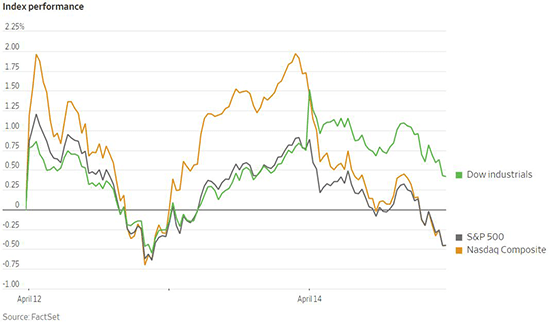
Major US stock indexes fell over the course of the shortened trading week as investors began to evaluate companies’ first-quarter earnings. The S&P 500 fell 2.1% while the Nasdaq Composite fell a further 2.6%. The Dow Jones Industrial Average held up better with a smaller loss of 0.8%. Profit margins will be examined critically this quarter to determine how companies are dealing with surging input costs and higher wages. The net profit margin for the S&P 500 is currently projected to be 12.1% for the first quarter, above its five-year average but below the record high of 13.1% from the second quarter of 2021. Analysts are still projecting earnings growth of 9.8% for the full year for the S&P 500. Expectations for tighter monetary policy from the US Federal Reserve weighed on bonds, sending the yield on the 10-Year US Treasury note up to 2.808% to end the week.
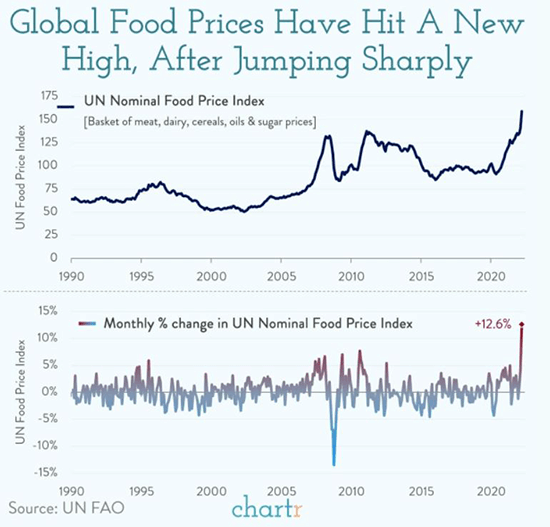
The release of new data from the US Labor Department last week showed that inflation continued to rise last month. The Consumer Price Index rose 8.5% in March compared to a year ago. The Core Consumer Price Index, which excludes the noise created by volatile food and energy prices, was up 6.5% in March relative to a year ago. Inflation in the United Kingdom hit 7% in March, exceeding estimates for the sixth straight month. Soaring energy costs in the UK now have many economists revising inflation estimates upward to as high as 9% for next month. Meanwhile the UN Food Price Index rose a full 12.6% in just one month, reaching a new record high for global food prices. While Asia to this point has been spared the high inflation currently being experienced in the West, there are some indications that higher food and energy costs are starting to fan inflation across the region as well. Producer Price Indexes are running hot in many countries, which are likely to filter through to Consumer Price Indexes eventually. These concerning data points increase the pressure on global central banks to tighten financial conditions to rein in inflation, possibly at the expense of economic growth.
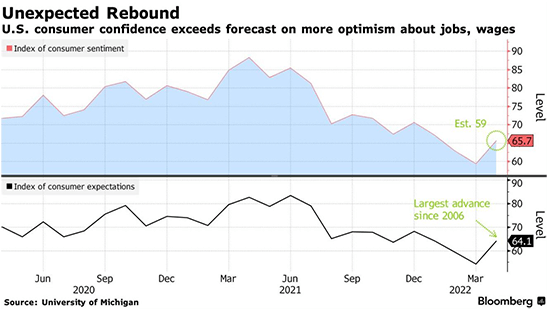
The interest rate on the average 30-year fixed-rate mortgage most popular in the US rose to 5% last week, the highest rate since 2011. Rates have risen dramatically since their all-time low just 15 months ago. This will make the housing market even more expensive to prospective buyers who are facing prices that have already appreciated significantly as well. So far, the US consumer is still holding up relatively well. The University of Michigan’s consumer sentiment index unexpectedly rebounded last month and far surpassed all forecasts. US retail sales rose 0.5% last month for a third straight month of gains in an encouraging sign of consumer demand. However, it should be noted that this was largely due to higher gasoline prices, which rose 18.3% in March. Excluding gasoline sales from the calculation would result in a fall of 0.3% in retail sales. JPMorgan’s first quarter results exhibited increases in credit card spending and deposits for consumers and small businesses, another indication that the US consumer remains in good financial health for now.
The representations and opinions herein are the opinions and views of EQIS Capital Management, Inc. ("EQIS"), a registered investment adviser. The information is believed to be reliable but is not guaranteed by EQIS. The information contained herein is for informational and comparison purposes only. The representations and opinions herein are the opinions and views of EQIS. When applicable, sources used in forming EQIS’s opinion are cited, however other sources may be available which contradict EQIS’s opinion, process and methodology. While EQIS believes the data to be reliable, no representation is made as to, and no responsibility, warranty or liability is accepted for the accuracy or completeness of such information. This material represents an assessment of the market environment at a specific time and is not intended to be a forecast of future events or a guarantee of future events. This information should not be relied upon as research or investment advice. EQIS does not provide legal or tax advice.
LF1662

 860-291-1998
 Schedule Demo