
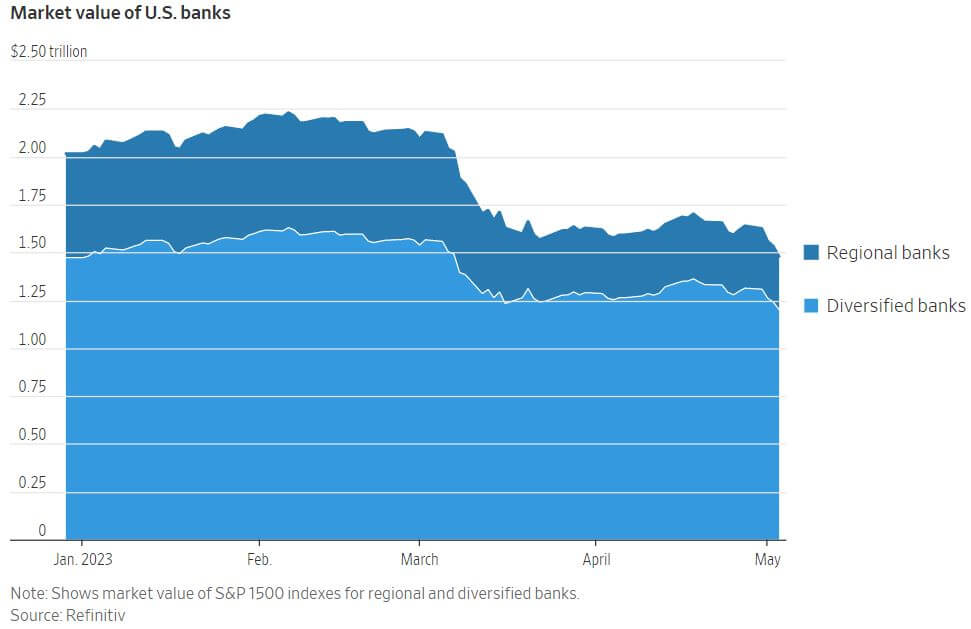
Financial markets ended a chaotic week with a rally in risk assets as regional banks rebounded from a brutal rout, with solid jobs data tempering fears of a recession. The S&P 500's longest losing streak since February halted as equities rallied, with the KBW Bank Index of financial heavyweights rebounding from its lowest since September 2020. PacWest Bancorp soared over 80% and Western Alliance Bancorp and First Horizon Corp. jumped, following a rout that saw their shares tumbling to a record low. Wall Street's favorite equity volatility gauge, the VIX, snapped a four-day surge to hover near 17. Strong earnings at Apple Inc. helped lift the megacap technology sector. With 85% of S&P 500 companies having reported earnings for Q1, earnings are now expected to fall 2.3% for the quarter, much better than the roughly 6% drop that was forecasted. A midweek bond rally driven by concerns about the economy and banking system was halted on Friday by strong US jobs data. Hiring remained robust and wages continued to rise, sparking a selloff in the Treasury market and pushing yields on Treasurys higher. The two-year yield surged to 3.92% from 3.73% on Thursday, with the yield on the 10-year note rising to 3.45% from 3.35%. Analysts said the conflicting signals about the economy were leaving many investors guessing about the path of rates, as concerns mounted over a significant lending pullback that could be looming.
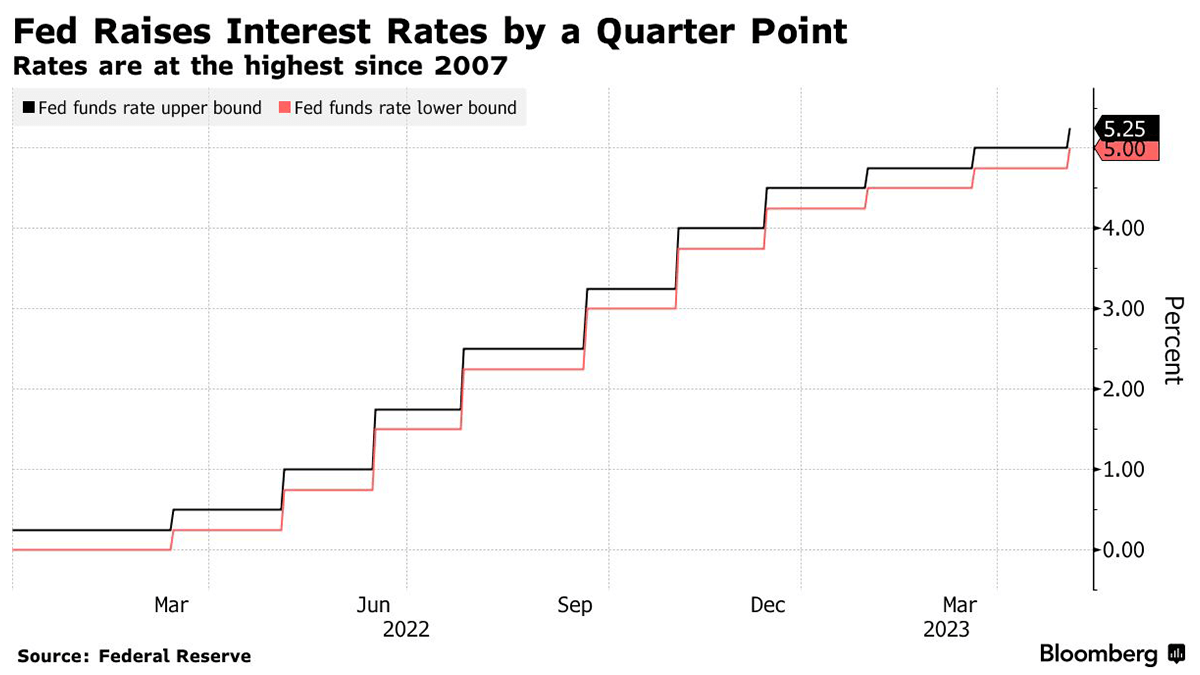
The US Federal Reserve raised interest rates by a quarter percentage point last week, bringing them to the highest level since 2007. The decision marked the 10th consecutive increase aimed at fighting inflation and took the benchmark federal funds rate to a range of 5% to 5.25%. The Federal Open Market Committee (FOMC) also hinted that this may be the last increase in the most aggressive tightening campaign since the 1980s, as economic risks mount. The FOMC omitted a line from its previous statement in March that said the committee “anticipates that some additional policy firming may be appropriate.” The FOMC has instead said it will take into account various factors “in determining the extent to which additional policy firming may be appropriate.” Policymakers are resolved to ensure inflation will continue decelerating, even as the banking system endures ongoing stress and lawmakers step up criticism. Though some data has suggested the labor market may be weakening, the April jobs report showed hiring picked back up to 253,000 new positions, the strongest monthly gain since January. The unemployment rate remained unchanged at 3.4%, while wages rose 4.4% from a year earlier in a slight acceleration compared to March. Although the Fed may be finished raising rates, Powell and his colleagues have pledged to keep them elevated for a time to make sure the central bank’s preferred measure of inflation continues receding toward the 2% target. However, prices of interest-rate futures have long signaled an expectation in markets that the Fed would pivot to rate cuts in coming months. Rates on swap contracts linked to Fed meetings moved higher, to levels consistent with a stable policy rate until September, followed by at least two quarter-point cuts by year-end. Meanwhile, the European Central Bank also raised its key interest rate last week by a quarter of a percentage point, its smallest rate hike since it started raising rates rapidly last summer.
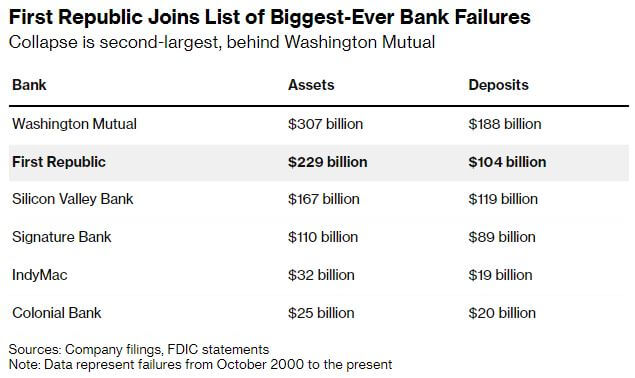
First Republic Bank, a California lender catering to wealthy clients, became the second-largest bank failure in US history last week with $229 billion of assets as of April 13. The bank was seized by the Federal Deposit Insurance Corp. on Monday after failing to recover from customer withdrawals and declining asset prices. First Republic had become vulnerable after the collapse of Silicon Valley Bank in March, which led to many depositors fleeing. The bank's deposit base collapsed, and it turned to expensive short-term borrowing to plug the gap. Loans it had made when interest rates were low had slumped in value, leading to worries about its solvency. JP Morgan Chase & Co. acquired First Republic Bank last week in a government-led deal after private rescue efforts failed and is taking over First Republic's assets, including $173 billion of loans, $30 billion of securities and $92 billion in deposits. The bank failure is the third to occur in the past several weeks, following the collapses of Silicon Valley Bank and Signature Bank. Though both the Fed and JPMorgan attempted to provide reassurance of the stability of the banking system following the successful sale, several other regional banks including PacWest and Western Alliance came under severe selling pressure from investors last Wednesday and Thursday, with PacWest’s share price falling to its lowest on record. However, the embattled banks rebounded strongly on Friday, recovering a great deal of the prior days’ losses as the volatility continues.

 860-291-1998
 Schedule Demo