
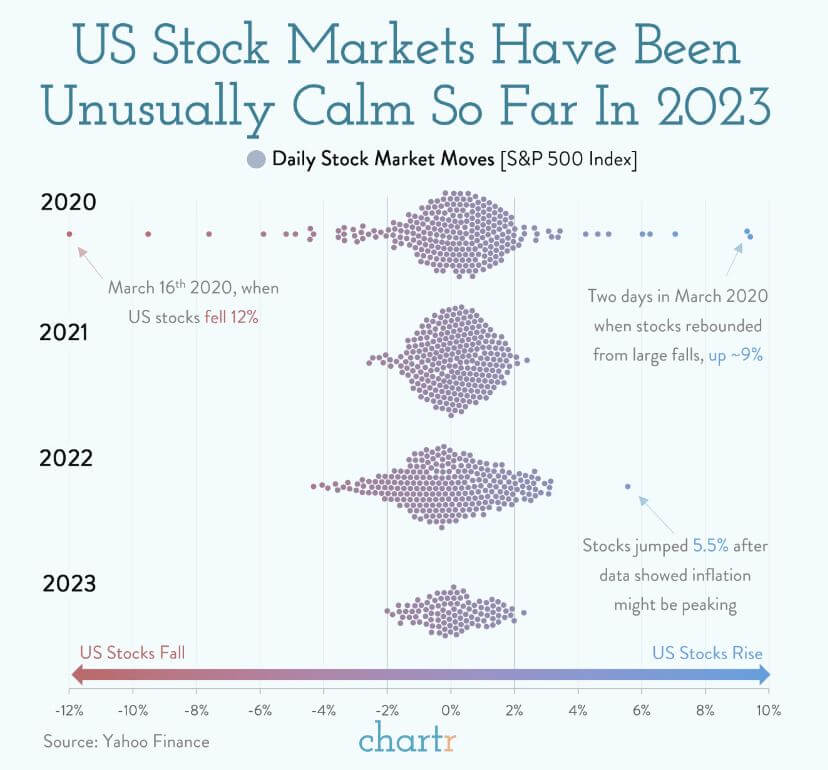
The U.S. stock market has remained surprisingly calm this year despite inflation, higher interest rates, and the possibility of recession. This can be attributed to a growing divide between mainstream investors and the machines that drive the market. Mainstream investors have largely stayed on the sidelines during the 2023 stock rally, citing high valuations and concerns about the U.S. economy. In contrast, quantitative funds, relying on computer models and automated trading, have been aggressively buying stocks, pushing their net exposure to the highest level since December 2021. While the demand from quant funds has provided support for the stock market, it also poses risks. Concentrated positions and leveraged buying by these funds could lead to significant unwinds in the event of a negative shock. Quant funds' dominance in the market is not a new phenomenon, as they have contributed to periods of calm trading in the past. However, abrupt selloffs have disrupted market stability, as seen in the 2018 "Volmageddon." Some market participants warn that a similar event could be on the horizon. The influence of computer-driven trading has ebbed and flowed in recent years, but its impact has been significant, as quant-focused hedge funds currently hold about $1.13 trillion in assets, representing 29% of all hedge-fund assets. The systematic and rule-based nature of quant trading means that when volatility strikes, these funds tend to move together quickly. The growing equity exposure of quant funds could leave stocks vulnerable in the future.
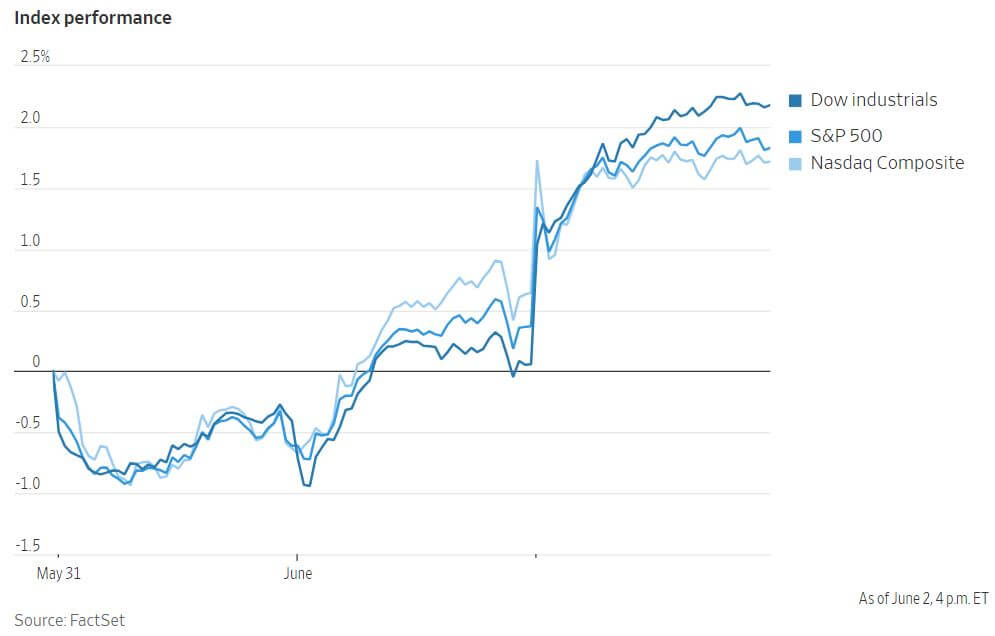
During the holiday-shortened week, the stock market performed well, with the S&P 500 approaching 4,300. The uncertainty surrounding the debt ceiling was alleviated as Congress passed a deal, which President Biden signed into law over the weekend. Labor and inflation data released during the week helped ease concerns about a recession and rate hikes. The May ISM Manufacturing Index showed a decline in new orders but also a slowdown in the Prices Paid Index. The May Employment Situation Report revealed an increase in nonfarm payrolls, a moderation in hourly earnings growth and a rise in the unemployment rate. The market response to the jobs report suggests that another rate hike is expected, but not necessarily in June. The bond market implies around 25 basis points of tightening over the next two meetings, with less than a 50% chance of a hike happening this month. While mega-cap stocks had been driving market action, there was a rotation of money into previously trailing sectors. The Invesco S&P 500 Equal Weight ETF outperformed the Vanguard Mega Cap Growth ETF. Retailers like lululemon, Advance Auto, Dollar General, and Macy's reported mixed earnings, resulting in notable market movements. The consumer discretionary and real estate sectors saw the largest gains, while utilities and consumer staples had slimmer gains. Treasury yields decreased, with the 2-year note yield falling five basis points to 4.51% and the 10-year note yield falling 11 basis points to 3.69%. As stocks climbed, the Cboe Volatility Index (VIX), often referred to as the "fear gauge," dropped to its lowest level in three years, indicating reduced market volatility. This risk-taking sentiment also propelled the Russell 2000 index of small caps, including regional banks, to rise by approximately 3.5%.
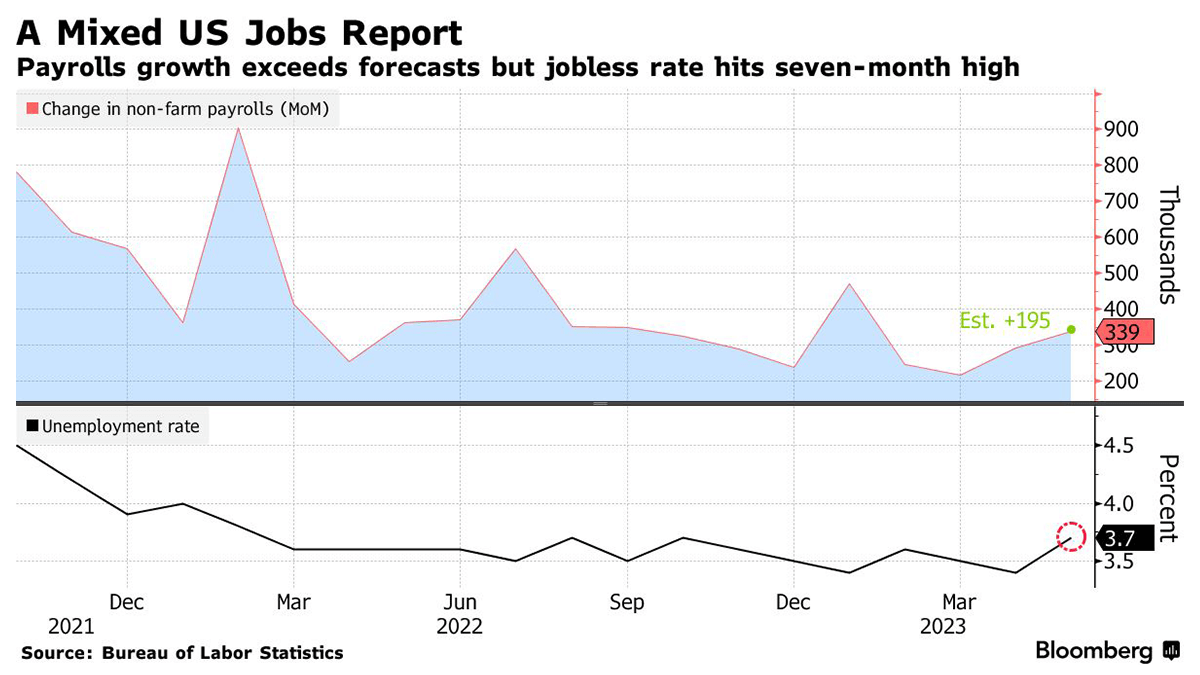
In May, hiring in the United States accelerated for the second consecutive month, indicating a resilient labor market despite rising interest rates and elevated inflation. According to the Labor Department, U.S. employers added 339,000 jobs last month, with upward revisions to the job totals for March and April resulting in a net gain of 93,000 jobs. However, the unemployment rate rose slightly to 3.7% from April's 3.4%. The strong hiring and low unemployment have contributed to upward pressure on wages, with average hourly earnings growing by 4.3% in May compared to the previous year, similar to the gains in March and April. Despite the positive overall hiring trend, there were some signs of weakness in the report. Unemployment rates increased for women and Black Americans, both of whom had seen improvements in joblessness in recent years. The average workweek fell to 34.3 hours, the lowest since April 2020, and average weekly earnings advanced at a slower rate than hourly earnings due to fewer hours worked. Additionally, the labor-force participation rate remained flat at 62.6% in May, below the pre-pandemic level of 63.3% in February 2020. Despite the overall resilience of the labor market, some sectors, such as tech, finance and manufacturing, showed signs of stress. The information sector, in particular, cut 9,000 jobs in May. Companies like Facebook's Meta Platforms, Goldman Sachs Group and Grant Thornton have recently announced job cuts. However, overall layoffs have remained low and job openings increased in April, according to the Labor Department.

 860-291-1998
 Schedule Demo