
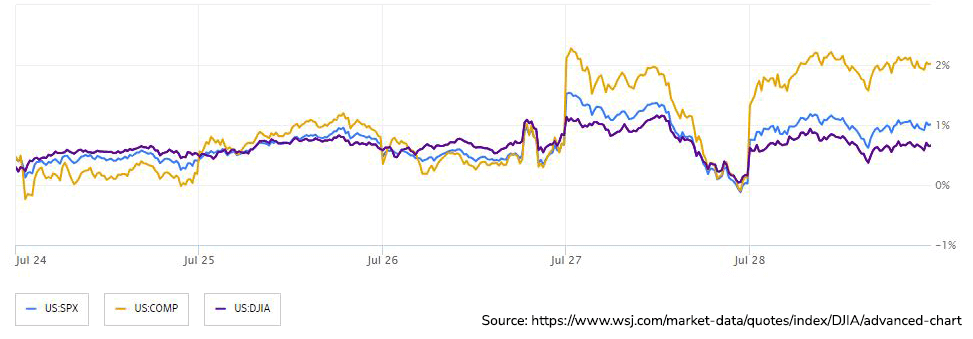
New US data last week increased the odds of a "Goldilocks scenario" of a balanced economy with growth that is neither too strong nor too weak, boosting confidence in the Federal Reserve's ability to avoid a recession. According to the Labor Department, employers' spending on wages and benefits in April to June increased by 4.5% from a year earlier, a slower growth rate than the previous quarter's 4.8% increase. The employment-cost index, closely monitored by the Fed, also saw its smallest quarterly increase in two years. The Commerce Department's data showed that the personal-consumption expenditures price index, the Fed's preferred inflation measure, rose 3% in June from a year earlier, down from the 3.8% rise in the previous month. These signs of inflation cooling down provided hope for investors, and US stocks rose on the day of the inflation figures' release. Tech firms' earnings reports indicated a shift in sentiment, with less talk about recession and more focus on artificial intelligence. This change in tone reflected increased optimism about the economic outlook, as companies were less concerned about headwinds and inflation compared to the previous year. US regional lenders saw a streak of weekly gains, bolstered by a merger deal for PacWest Bancorp. Procter & Gamble Co. rallied after reporting better-than-expected earnings, while Ford Motor Co. faced a setback due to anticipated losses from electric vehicles. Exxon Mobil Corp. also experienced a drop in profit, falling short of analysts' expectations for the third consecutive quarter.
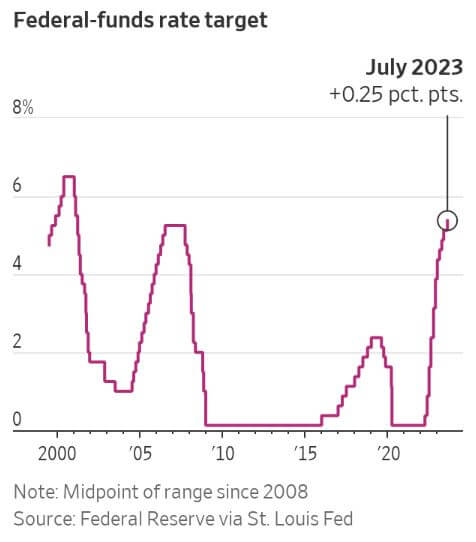
The Federal Reserve, in a unanimous decision, raised its benchmark federal-funds rate by a quarter-percentage-point last week, bringing it to a 22-year high. Fed Chair Jerome Powell, in a news conference following the meeting, indicated that while another rate increase at the next meeting is not ruled out, the central bank has already taken substantial measures to address inflation. The markets' reaction to the decision was mixed, and the trajectory of further rate increases remains uncertain. Economic growth has been strong, but recent data showing a slowdown in inflation might reduce pressure on the central bank to continue raising rates. Fed officials are particularly concerned about core inflation, which excludes volatile food and energy prices. The decision on further rate increases may depend on how the economy evolves and whether inflation continues to cool.
Meanwhile, the European Central Bank (ECB) raised its key interest rate by 0.25 percentage point, marking the ninth consecutive rate increase and bringing the deposit rate to 3.75%, the highest level in 22 years. However, the ECB also signaled a possible pause in its rate hike campaign due to the Eurozone's weaker growth compared to the United States and the dilemma of balancing high inflation with the threat of recession. The rate increase caused the euro to decline in value against the dollar, as investors interpreted the move as a sign that the ECB would be cautious about further rate hikes. ECB President Christine Lagarde acknowledged the deteriorating outlook for the Eurozone economy, particularly in the manufacturing sector, and stated that future rate decisions would depend on incoming economic data. Europe's economic growth has been slowing, especially in Germany, and bank lending is declining. In contrast, the jobs market has remained robust and wages are rising. Inflation in the Eurozone declined to 5.5% in June, the lowest in nearly 18 months but still far above the ECB's target of 2%. Core inflation, which excludes food and energy, has remained around 5% for nearly a year, raising uncertainties whether more rate hikes are required.
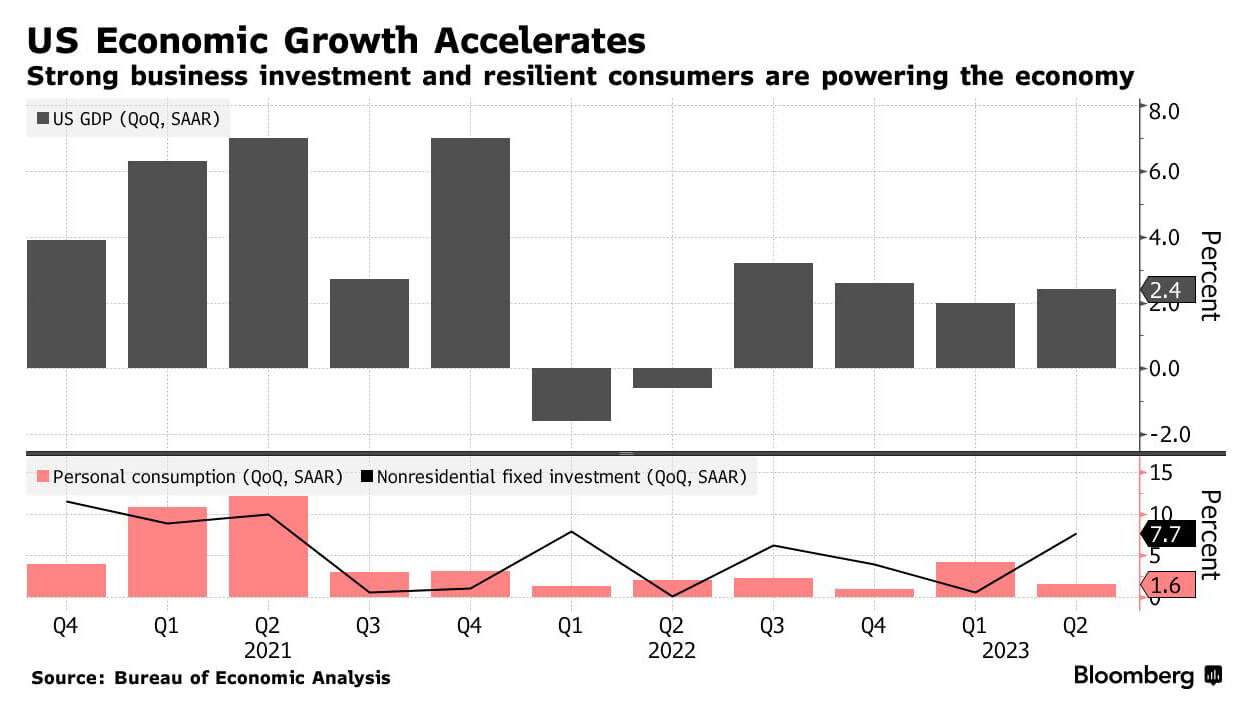
The U.S. economy grew in the second quarter, with a gross domestic product (GDP) increase of 2.4%, slightly higher than the 2% growth in the previous three months. Consumer spending contributed to the growth, but at a slower rate for both goods and services. A major driver of economic growth, consumer spending grew at an annual rate of 1.6% in the second quarter, down from 4.2% in the previous quarter. This slowdown was partly due to reduced purchases of big-ticket items such as vehicles, after a surge in the first quarter. Business investment was strong during the period, particularly in buildings and equipment, and inventory rebuilding also boosted output. Business investment rose at an annual rate of 7.7% during the second quarter, compared to 0.6% in the first quarter. Long-term forces, such as increased federal spending on chip-manufacturing plants and electric-vehicle factories, offset some cutbacks, contributing to the positive investment figures. Despite the Federal Reserve's efforts to raise interest rates, the economy remained resilient, and concerns about a recession have eased. Economists have revised their expectations of a recession, now seeing a more balanced probability of continued economic expansion versus contraction. Wage gains and a strong labor market continued to support consumer confidence. Small businesses are also feeling less pessimistic about the economy.

 860-291-1998
 Schedule Demo