
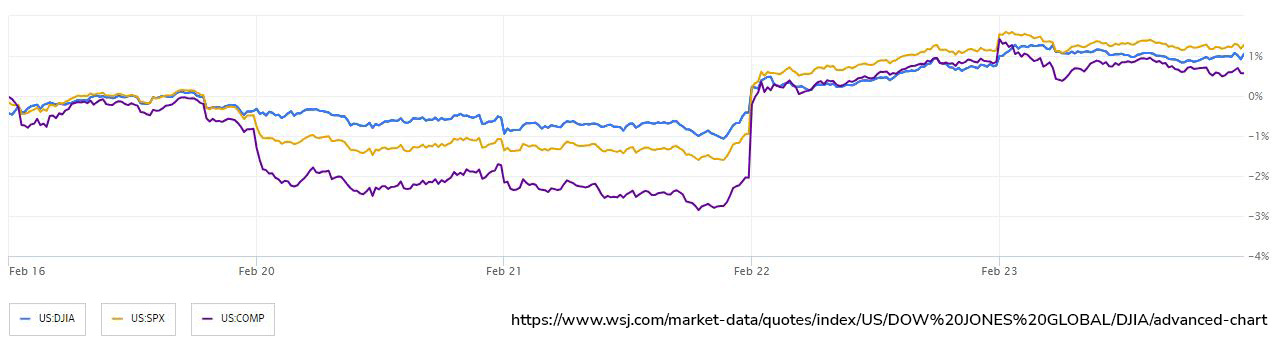
The S&P 500 briefly surpassed the historic 5,100 mark, driven by multiple record-setting performances in the world's largest equity market. Mark Haefele from UBS Global Wealth Management highlighted investor uncertainty regarding whether to capitalize on the rapid tech rally. Despite the temptation to rebalance portfolios, strategic exposure to US large-cap technology remains crucial, according to Haefele, suggesting further potential upside for tech stocks. Bank of America Corp.'s Michael Hartnett identified a potent combination of factors including a rally in AI and optimistic economic growth amid easing monetary policy, describing it as a "magic sauce" for driving equity market gains. He noted a shift in tone from bearish to neutral on stocks, highlighting the emergence of a "baby bubble" in AI. Federal Reserve Bank of New York President John Williams expressed optimism about the economy's trajectory, hinting at potential rate cuts later in the year. Chris Zaccarelli from Independent Advisor Alliance emphasized the dominance of bullish sentiment in the market, driven by technical tailwinds and positive fundamentals. David Donabedian at CIBC Private Wealth US cautioned against betting against the market's momentum, particularly in the short term. While concerns about a potential tech bubble persist, Barclays Plc strategists argued that current price movements align with earnings fundamentals. Greg Marcus at UBS Private Wealth Management endorsed a "buy-the-dip" approach for big tech stocks amid anticipated pullbacks and volatility. Despite the strong rally in tech stocks, Marcus noted a narrow market breadth, suggesting a potential shift away from the dominance of the "Magnificent Seven" if anticipated rate cuts by the Fed materialize. Goldman Sachs economists reduced their forecast for rate cuts, now expecting four reductions this year instead of five, while JPMorgan Chase & Co. raised year-end forecasts for Treasury yields.
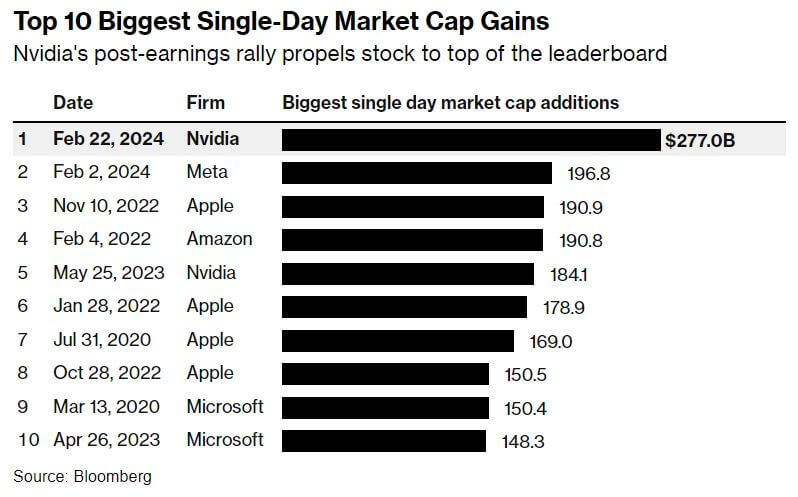
Nvidia, a leading chip company deeply entrenched in the advancement of artificial intelligence (AI), has recently demonstrated remarkable financial performance, showcasing a substantial increase in quarterly sales compared to the previous year. In its latest fiscal quarter, Nvidia's revenue reached $22.1 billion, surpassing analysts' expectations, while net profit soared to $12.29 billion, a significant leap from the previous year's $1.41 billion. The company's optimistic outlook extends into the current quarter, with a sales forecast of approximately $24 billion, further exceeding Wall Street's projections. This stellar financial performance has been accompanied by a surge in Nvidia's stock value, which has more than tripled over the past year, underscoring investors' confidence in the company's growth trajectory. Nvidia's consistent ability to exceed expectations and set ambitious targets has positioned it as a key indicator of the strength of the AI industry. CEO Jensen Huang attributes this success to the increasing demand for computing power fueled by the widespread adoption of AI across various sectors and geographies. He describes AI as reaching a "tipping point," emphasizing the astronomical demand for the technology's underlying computational capabilities. Nvidia's evolution from a gaming-focused chip company to a central player in the AI landscape has been swift and dramatic. Notably, Nvidia's dominance in AI computation is evident, with an estimated market share exceeding 80%. However, Nvidia's growth has not been without challenges. The company has faced constraints due to overwhelming demand for its chips, leading to a prolonged shortage exacerbated by supply chain complexities. Additionally, geopolitical tensions, particularly restrictions on chip sales to China imposed by the Biden administration, have posed further obstacles to Nvidia's expansion efforts. In response to Nvidia's dominance, competitors like Advanced Micro Devices (AMD) are striving to gain market share in the AI computing space. Looking ahead, Nvidia's continued success hinges on its ability to address supply chain constraints, navigate geopolitical challenges, and innovate to maintain its competitive edge in the rapidly evolving AI landscape. Following the release of the earnings data, its shares rallied 16% on Thursday. That equates to a roughly $197 billion gain in market value, the largest single-day increase in a stock’s market value in history. Last week’s rally pushed Nvidia’s market capitalization past $2 trillion.
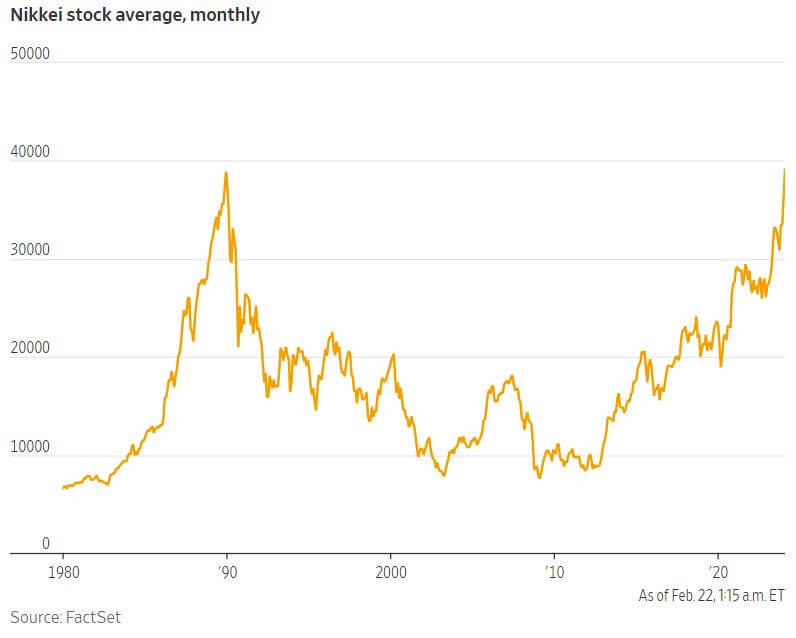
The recent attainment of a record high in Japan's benchmark stock average after a lengthy 34-year hiatus can be attributed primarily to the robust profitability of Japanese corporations. With the 225 companies comprising the index anticipated to accrue approximately $266 billion in profits during the current fiscal year—tripling the earnings of a decade ago—the resultant market capitalization of around $4.6 trillion underscores the financial health of these enterprises. This surge in earnings, buoyed by a combination of a depreciating yen and pressure from foreign activist investors, reflects a concerted effort by Japanese firms to enhance their global competitiveness and divest underperforming assets. Moreover, recent inflationary trends on a global scale have enabled Japanese companies to bolster prices and profit margins, marking a notable departure from decades of stagnant growth. Notable examples include Toyota's projected $30 billion earnings for the fiscal year, nearly doubling its previous year's profits, and Daikin's exponential profit growth facilitated by strategic acquisitions and market expansion. This transformative shift traces its origins to December 2012 when Shinzo Abe assumed office as prime minister for the second time, launching an ambitious economic revitalization program dubbed "Abenomics." Under Abe's leadership, the government implemented structural reforms aimed at fostering greater corporate accountability and shareholder returns, complemented by accommodative monetary policies that bolstered export competitiveness. The culmination of these efforts, coupled with subsequent economic stimuli and capital inflows amidst global geopolitical shifts, culminated in the Nikkei's historic ascent. Foreign investment, attracted by Japan's perceived stability vis-à-vis China and the allure of robust corporate returns, has further fueled market dynamics, exemplified by the substantial increase in dividends and share buybacks by Japanese firms.

 860-291-1998
 Schedule Demo