
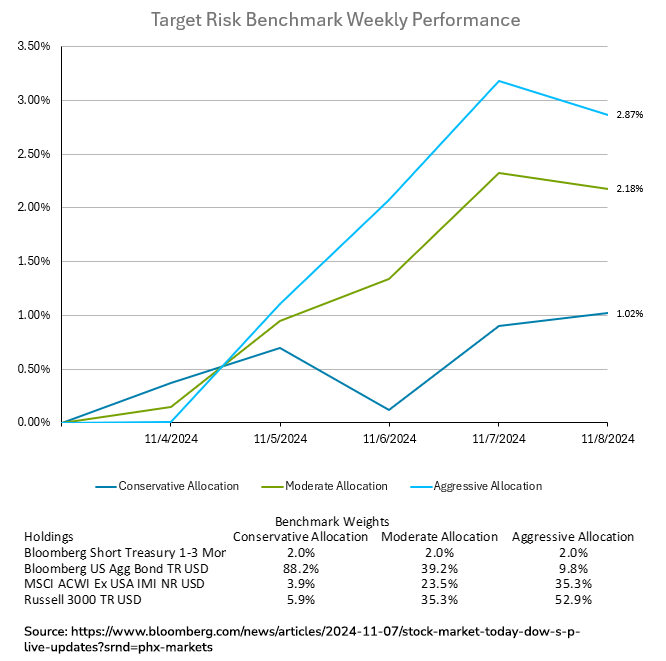
U.S. stocks ended their strongest week of 2024 with gains, buoyed by positive consumer sentiment and optimism over newly elected President Donald Trump’s anticipated policies. The S&P 500 rose for the fourth consecutive session, reaching a 4.7% weekly increase and hitting its 50th record high this year. Tesla’s rapid rise helped it reclaim a trillion-dollar valuation, while defensive stocks took the lead on Friday as some sectors rebounded from oversold conditions. Investor enthusiasm following Trump’s election victory saw $20 billion flow into U.S. equities, the highest inflow in five months, according to Bank of America. Small-cap stocks, seen as potential beneficiaries of Trump’s protectionist policies, experienced their largest inflow since March. The S&P 500 briefly topped the psychologically significant 6,000 level, which analysts say could further attract sidelined investor capital currently held in bonds and money market funds. Despite the strong post-election rally, some experts, like Clark Geranen of CalBay Investments, predict a temporary market pause before further gains toward year-end. Treasury yields on the 10-year note dropped slightly to 4.30%, while the dollar extended its rally for a sixth week, reflecting continued investor confidence in the U.S. economy’s resilience and growth potential under the new administration. The post-election rally benefited investors across all risk tolerances. The aggressive target risk benchmark below benefited the most from the election results with a gain of 2.87% for the week. The moderate target risk benchmark also enjoyed a healthy return of 2.18% for the week. Even the conservative target risk benchmark participated, ending the week up by 1.02%.
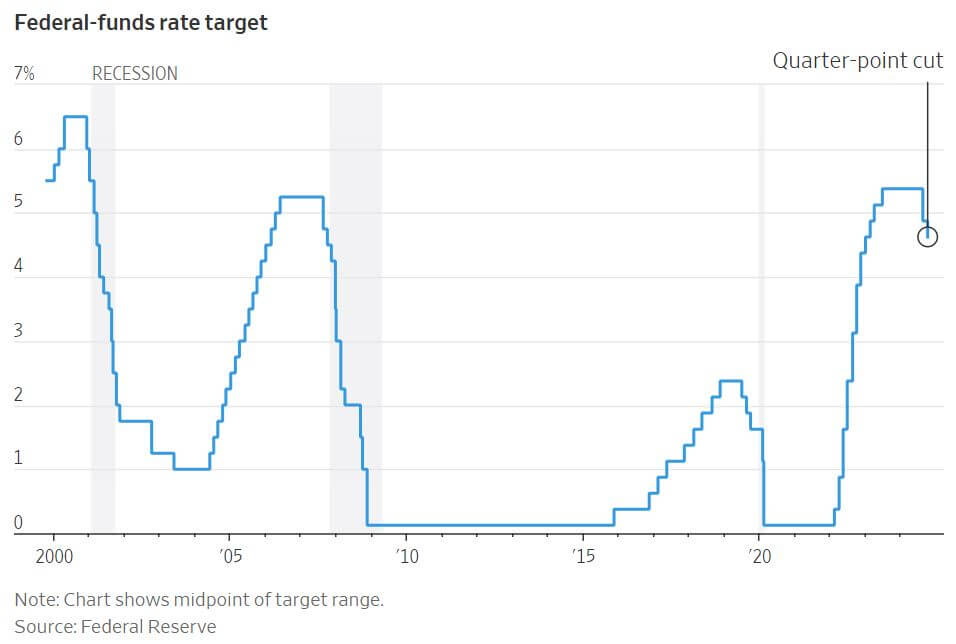
The Federal Reserve approved a quarter-point interest rate cut last week, bringing the federal funds rate to a range between 4.5% and 4.75%. This move, unanimously backed by all 12 Fed officials, aims to protect the labor market from the impact of high rates set in the past 2½ years while inflation moderates. Fed Chair Jerome Powell expressed confidence that, with adjusted policies, inflation can be controlled without destabilizing economic growth. Following Donald Trump’s recent re-election, economists are split on whether potential GOP-led policy shifts could spur or slow economic growth. On Wall Street, this shift has fueled speculation about the Fed’s future rate cut plans. Though Fed officials had projected a gradual rate reduction, rising bond yields and concerns over higher deficits have led to an unusual situation where borrowing costs—such as mortgage rates—have increased even as the Fed cuts rates. The average 30-year mortgage rate, for example, rose from 6.1% to 6.8% since mid-September. The Fed’s primary goal is to achieve a "neutral" rate that neither accelerates nor dampens growth, though officials are uncertain where this level lies. Before the 2008 financial crisis, a neutral rate was seen near 4%, but recent estimates suggest it may be closer to 2%. With inflation at 2.1% and core inflation at 2.7% in September, officials remain cautious about further cuts. The next potential cut is anticipated in December, but mixed economic signals—such as steady consumer spending despite a cooling labor market—are creating a complex decision-making environment for the Fed.
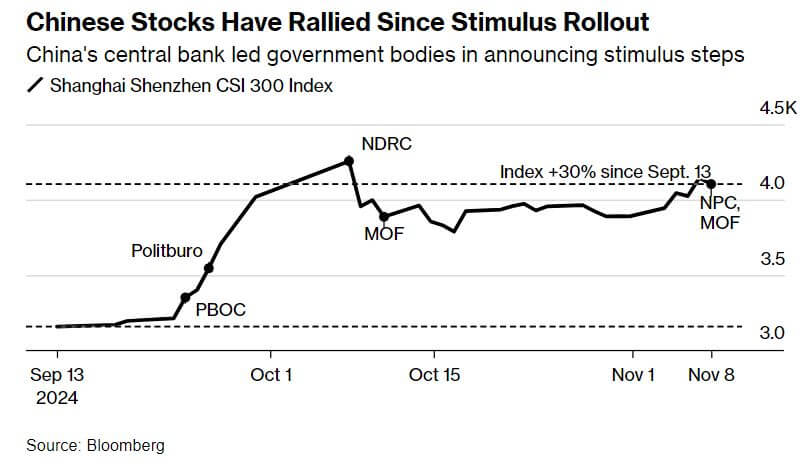
China has introduced a 10 trillion yuan ($1.4 trillion) program to help refinance local government debt, aimed at easing financial strain without triggering major new stimulus. The plan, detailed by officials in Beijing, allows local governments to shift "hidden" debt onto public balance sheets, with funds available through 2028. This cautious approach leaves space for a stronger response if trade tensions with the U.S. escalate after Donald Trump takes office. While not introducing direct economic stimulus, Finance Minister Lan Fo’an signaled a “more forceful” fiscal approach for 2024, hinting at further action depending on Trump’s policies. As the U.S. president-elect considers high tariffs on Chinese goods, China’s leaders have avoided immediate moves, preferring a wait-and-see stance. Recent stimulus steps have boosted China’s stock market by 30% since September, helping stabilize growth without adding substantial new debt. However, investors, anticipating more spending on domestic demand, expressed disappointment when the package’s scope became clear. China's local debt burden has grown, partly due to reduced revenue from land sales amid a property slump. The program aims to address this by raising local governments’ debt ceiling, allowing an extra 6 trillion yuan in bonds over three years to restructure existing debt. An additional 4 trillion yuan in bonds will be available by 2028. Economists see the debt swap as essential for financial stability, though it may only indirectly support economic growth. Some analysts argue more direct fiscal measures are needed to stimulate consumption and ensure robust growth. Investors await further developments, expecting clearer policy directions at the Politburo’s December meeting and the annual Central Economic Work Conference.

 860-291-1998
 Schedule Demo