
Wall Street's optimistic outlook for 2025 has quickly stumbled, with markets facing turbulence just ten days into the year. A strong U.S. labor market report on Friday triggered a selloff, as traders interpreted the data as reducing the likelihood of further monetary easing by the Federal Reserve. The S&P 500 dropped 1.5% for the week, while Treasury yields climbed, with 30-year rates exceeding 5%. This volatility highlights a challenging environment where strong economic data is no longer a boon for markets. Rising interest rates are straining debt-laden companies and interest-sensitive strategies, casting doubt on the so-called "Trump trade" that anticipated equities booming under pro-growth policies. Instead, surging bond yields, driven by concerns over inflation fueled by tariffs and spending, are complicating financing and policy implementation. Investors face a precarious landscape of high valuations, policy uncertainty, and stubborn inflation. Combined returns on stocks and bonds have been negative for five consecutive weeks, the longest stretch since 2023.
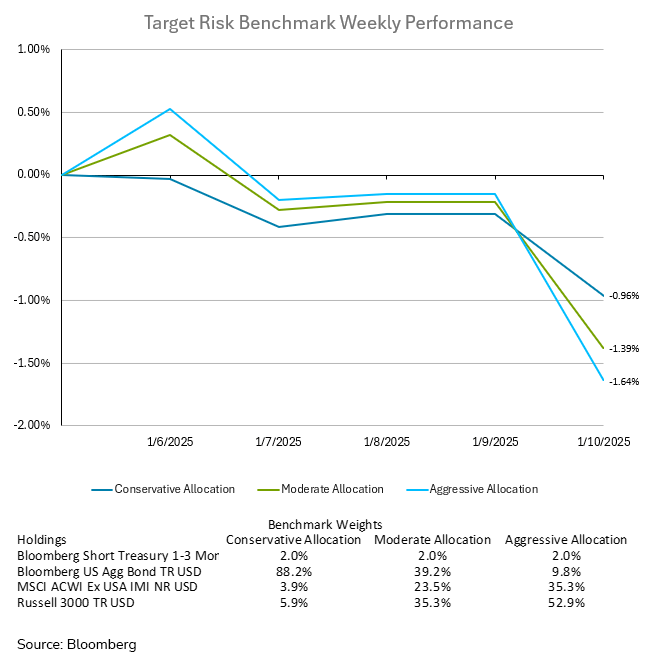
With equities and bonds selling off in tandem, investors across all risk tolerances experienced losses last week. The aggressive target risk benchmark fared the worst as the equity decline was the most pronounced across asset classes, dropping by -1.64% for the week. The moderate target risk benchmark did not hold up much better with a decline of -1.39%. Conservative investors were not spared due to the spike in bond yields, ending the week with a loss of -0.96%.
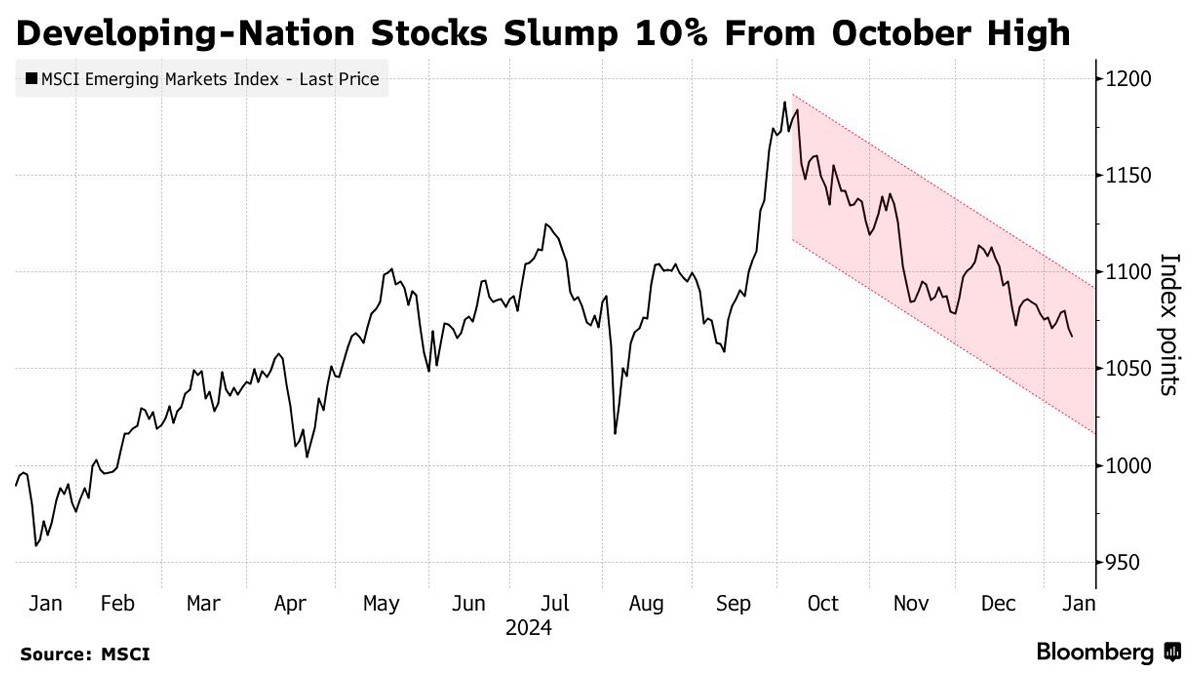
Emerging-market equities and currencies have experienced significant volatility, with the MSCI EM stock index entering correction territory after a 10% decline from its October peak. Key drivers include U.S. policy uncertainty, China's muted economic growth, and global inflation dynamics. The index, heavily weighted by Chinese equities, has been impacted by disappointing stimulus measures and persistently weak economic indicators. Chinese tech stocks are poised for their largest weekly drop in nearly two months. Broader sentiment remains fragile amid concerns over low inflation and sluggish growth in the world’s second-largest economy. Semiconductor giants Samsung Electronics and Taiwan Semiconductor Manufacturing Co. were leading decliners due to anticipated U.S. restrictions on global semiconductor trade under the last days of the Biden administration. Meanwhile, developing currencies weakened as the U.S. dollar strengthened, with the Chilean peso, Mexican peso, and South African rand among the hardest hit. Global inflation concerns persist, despite the Federal Reserve's monetary easing path, leading to market recalibrations for future interest rate cuts. This, coupled with rising U.S. Treasury yields and policy ambiguity ahead of Donald Trump’s inauguration, has further dampened risk appetite. Analysts anticipate market turbulence in response to Trump’s proposed tariffs and unpredictable commentary. Brazilian and South Korean equities added to the drag on the MSCI index, influenced by fiscal issues in Brazil and South Korea’s political instability. Investors are cautious but optimistic about undervalued opportunities emerging once policy clarity improves.
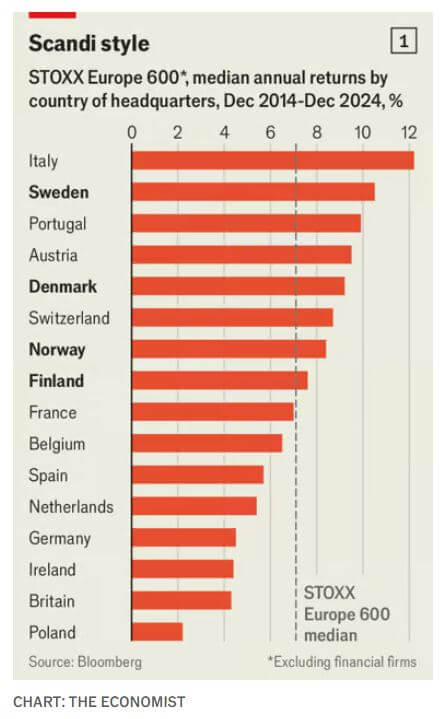
Nordic countries, despite their small size and modest global economic footprint, have produced an outsized number of global corporate giants, from Lego and IKEA to Spotify and Novo Nordisk. This success can be attributed to several interlinked factors that differentiate Nordic firms from their global peers. First, Nordic businesses have a deeply ingrained international outlook, necessitated by the small size of their domestic markets. Companies like Pandora and Maersk generate the majority of their revenues abroad, with domestic sales often accounting for less than 2% of total revenues. This global perspective encourages innovation and competitiveness on the world stage. Second, Nordic firms are pioneers in adopting and leveraging technology. Their enthusiasm for innovation is reflected in high rates of cloud-computing adoption and thriving startup ecosystems in cities like Stockholm and Helsinki. These innovations are underpinned by supportive social policies that mitigate risks for entrepreneurs, fostering a culture of experimentation and growth. Third, favorable government policies bolster the region’s business environment. While personal taxes are high, corporate taxes are competitive, and regulatory frameworks are business-friendly. Nordic governments embrace digitization, streamlining processes such as business registration, and promoting open, efficient markets. Fourth, Nordic firms benefit from long-term, patient ownership structures. Family dynasties, non-profit foundations, and domestic shareholders dominate corporate ownership, enabling companies to focus on sustained growth and invest heavily in research and development. However, challenges loom. Increasing geopolitical tensions, trade barriers, and the complexities of operating abroad threaten Nordic firms' reliance on global markets. Yet, their adaptability—a hallmark of Nordic business culture—positions them to weather these headwinds.

 860-291-1998
 Schedule Demo